Friday, February 17, 2012

Exploring Stars

Since we learned that our sun is a star, our questions led us to learn more about other types of stars. We learned that stars are mostly made of gas. We used a helium balloon to illustrate our stars float in space. 

We illustrate the formation of stars using paper clips and magnet wands. We used magnet wands to illustrate gravity and how it swirls around in space and attracts dust and gas to form a star.


We learned that there are millions of stars in the Solar System. To our surprise, the sun is not the biggest or hottest star!


We illustrated the different color and temperatures of stars: red is a cool star, yellow is a hot star, white is a hotter star, a blue star is the hottest.


We created stars and hung them from the ceiling of our classroom.

As well as added stars to our Solar System documentation outside of our classroom. 


After visiting a traveling planetarium at our school, we decided as a class to create our very own planetarium. Using two large cardboard boxes, we painted the inside black to represent the night sky. We then decided to paint the outside a combination of blue and black. 

We planned where to place the stars using a white crayon. We created the constellations The Big Dipper and Little Dipper onto our planetarium.

Carefully, we poked twinkle lights into the planetarium to represent stars.

At last, the planetarium was complete! We loved gazing at the beautiful stars from our very own classroom!


Saturday, February 11, 2012

The Sun

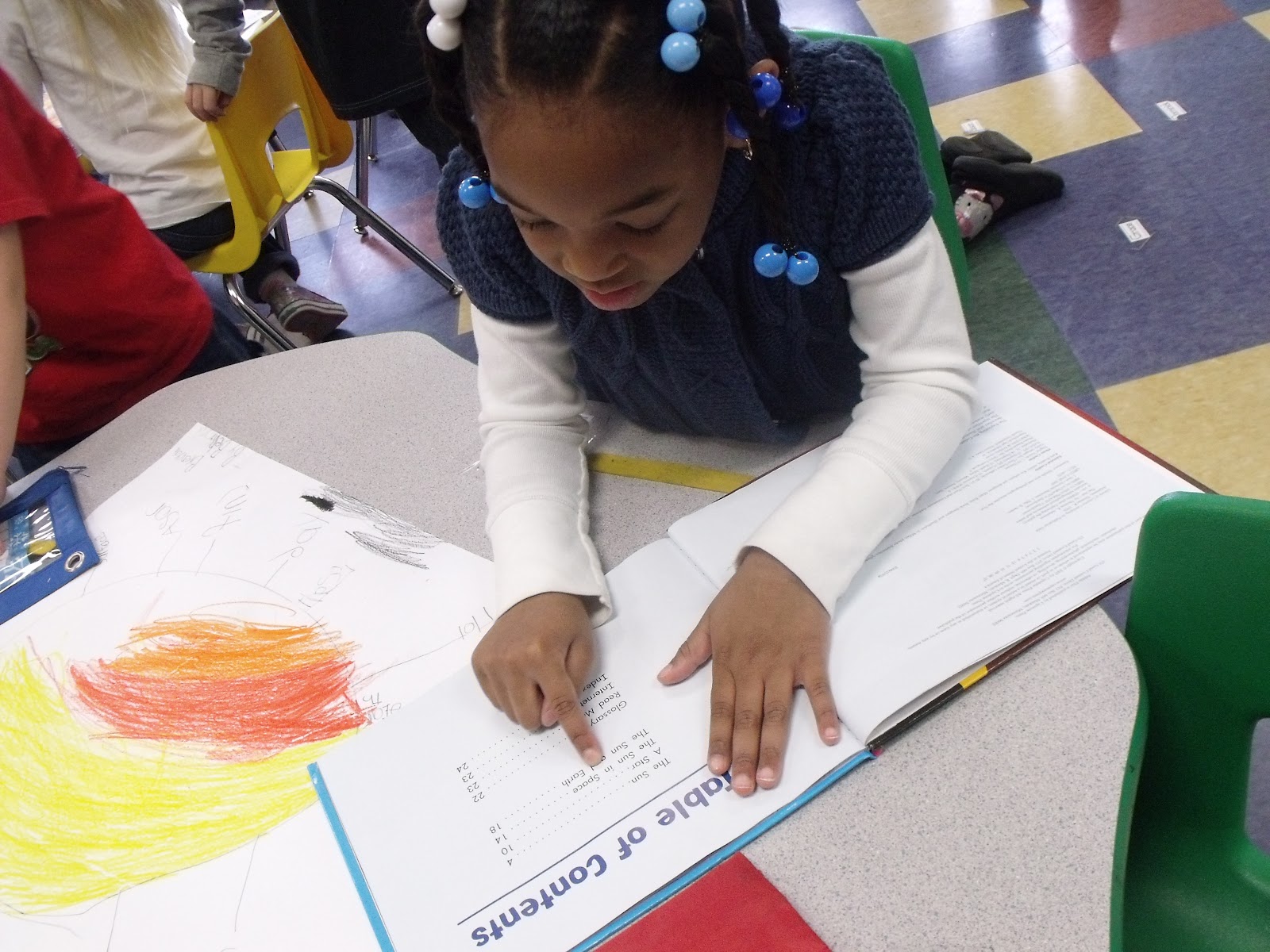
After exploring planet Earth, we began to notice the importance of the Sun to planet Earth. We know that we cannot survive on Earth if we did not have any sunlight. So, we became experts on the Sun. We read several non-fiction books about the Sun. We learned that the Sun is a very hot star made of gas.

We learned that the Sun is the center of the solar system and that all of the planets in the solar system orbit around the Sun. We wanted to share our learning with other kindergarten students, so the students decided to create non-fiction posters about the Sun. The students worked in small groups and decided which fact to share. They made sure to write their fact and draw a matching illustration. 


We presented our non-fiction posters to another kindergarten class. The boys and girls did an amazing job presenting their posters and sharing their knowledge about the Sun.


We learned that it takes the Earth 1 year to orbit around the Sun. We began to discuss that our age correlates to how many trips we have made around the Sun. So, we created a class book to show how many trips each of the students have made around the Sun.


100 Days of Kindergarten

Each day of school, we record how many days we have been in kindergarten. So of course when we reach the 100th day of school, we have a huge celebration! We had a wonderful day celebrating working hard and being 100 days smarter! 


Each student was asked to bring in a collection of 100 items from home for our Museum of Hundreds. We set up our Museum of Hundreds and invited Ms. Fleming's class to view our Museum. 


We also spent lots of time counting to 100 and singing our 100's song on the Promethean Board!

We adorned our room with 100th Day of School posters.


And created what we will look like when we are 100 years old.


We had a wonderful 100th day of school. I am so proud of every boy and girl. They have worked so hard in our first 100 days of kindergarten!